Understanding Pitch: Music Theory Basics for Musicians with TunerNinja
Have you ever played a beautiful melody on your guitar or piano, only to feel that something was slightly "off"? Even if you hit the right notes, the music might sound dull, tense, or unprofessional. To achieve professional sound quality, you must look beyond just the basic note name. The subtleties make all the difference. The answer often lies in a fundamental lack of understanding regarding pitch and tuning accuracy.
Many musicians, especially beginners, view tuning as a chore rather than a vital skill. However, understanding the science of sound is what separates a student from a master. By learning the basics of music theory, you can transform your playing from "okay" to "exceptional." Whether you are a bedroom hobbyist or an aspiring professional, mastering pitch is your first step toward musical excellence. Precision is the hallmark of a master, and your dedication to perfect tuning will pay off in every performance.
Let's dive into the core concepts of pitch, frequencies, and cents. We will also show you how a precise tuning tool can help you apply this knowledge in real-time. By the end of this guide, you will have the "ninja-like" precision needed to make every note count and your performance shine.

What is Pitch in Music?
At its simplest level, pitch is how high or low a note sounds to our ears. When you press a key on a piano or pluck a string on a guitar, you create a sound that vibrates at a specific speed. Our brains interpret these vibrations as musical notes. Understanding this concept is the foundation of all music theory basics. Like a ninja identifying a target from a distance, your ears must learn to pinpoint exact frequencies with clarity.
The Science of Sound Waves and Pitch
Sound travels in waves. When an object vibrates, it pushes the surrounding air molecules, creating pressure waves. The speed of these vibrations is called "frequency." If an object vibrates quickly, it produces a high pitch. If it vibrates slowly, it produces a low pitch.
Frequency is measured in Hertz (Hz), which counts how many vibrations occur per second. For example, a note vibrating at 440Hz is much higher than a note vibrating at 110Hz. As a musician, you don't need to be a physicist. However, knowing that pitch is based on measurable waves helps you understand why using an online chromatic tuner is so effective for staying in key.
How Instruments Produce Different Pitches
Different instruments create pitch in different ways, but the physics remains the same.
- String Instruments: Pitch is determined by the string's length, tension, and thickness. Tightening a guitar string increases its tension and raises the pitch.
- Wind Instruments: Pitch depends on the length of the column of air. Closing more holes on a flute makes the air column longer, resulting in a lower pitch.
- Percussion: Pitch is often determined by the size and material of the vibrating surface, such as a drumhead or a xylophone bar.
The Relationship Between Notes and Musical Intervals
In Western music, we organize pitches into a system of 12 notes. The distance between two pitches is called an "interval." The most basic interval is the octave. If you play a middle C and then the C above it, you have moved one octave.
Mathematically, an octave higher means the frequency has exactly doubled. Understanding these relationships allows you to navigate your instrument with confidence. When you use a free instrument tuner, you are essentially checking if your instrument's vibrations match these established mathematical intervals.
Understanding Cents in Tuning
While we talk about notes like A, B, and C, music is much more detailed than just 12 steps. This is where the concept of "cents" becomes vital. To achieve professional sound quality, you must look beyond just the basic note name. The subtleties make all the difference in how your audience perceives your skill level.
What Are Cents and How Small Is a Cent?
A "cent" is a unit of measurement used for musical intervals. Imagine a single semitone (the distance between two adjacent keys on a piano, like C to C#). In music theory, that semitone is divided into 100 equal parts. Each part is one cent.
Therefore, there are 1,200 cents in a full octave. Cents allow musicians to measure tiny variations in pitch that are too small to be called a different note. If your guitar string is 5 cents sharp, it is still an "E," but it is slightly higher than it should be.
Why ±0.1 Cents Matters in Professional Tuning
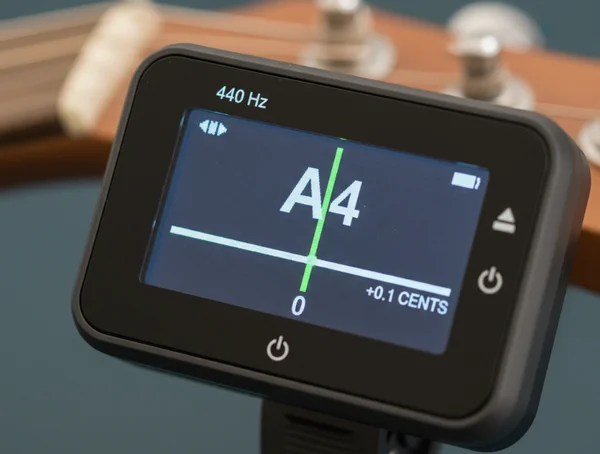
Most basic tuners have an accuracy of about ±1 or ±2 cents. For a casual practice session, this might be enough. However, for recording, performing in an ensemble, or setting up a new instrument, you need much higher precision.
This is why professional-grade tools like TunerNinja offer accuracy down to ±0.1 cents. Even a 1 or 2 cent deviation creates "beating"—that wobbling sound you hear when conflicting sound waves interfere with each other. Achieving ±0.1 cent accuracy ensures that your chords sound crystal clear and your harmonies are perfectly locked in. You can try our free tool to see this level of precision in action.
Human Perception of Pitch Differences
Can humans actually hear a difference of one cent? It depends on the person and the context. Professional musicians and tuners can often detect differences as small as 2 or 3 cents. Training your ears is like a ninja practicing in the dark; you learn to sense the slightest shift in the environment. Most untrained listeners might not notice a 5-cent error in a single note, but they will definitely feel that a chord sounds "sour" or "muddy" if the strings aren't perfectly aligned.
By training with a high-accuracy tuner, you actually "tune" your own ears. Over time, your brain becomes better at recognizing perfect intervals. This is the first step toward developing relative pitch or even perfect pitch.
Music Frequencies Explained
To truly master your instrument, you should understand the "standard" that the modern music world uses. This ensures that when you play with others, you are all speaking the same musical language. It prevents the frustration of being out of sync with your fellow performers.
The A440 Standard and Why It Matters
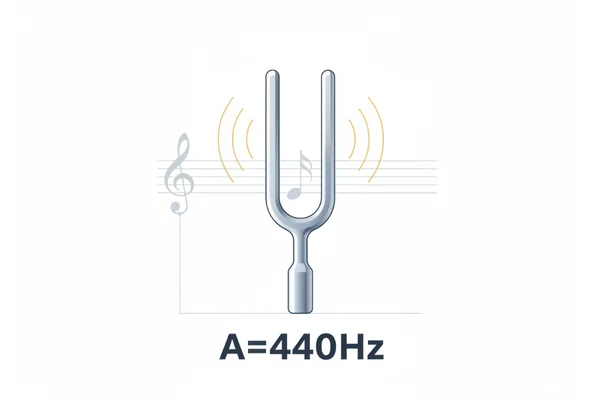
In 1955, the International Organization for Standardization established A440 as the standard pitch for the note A above middle C. This means the note vibrates at exactly 440 cycles per second.
Before this standard existed, different orchestras tuned to different frequencies. This made it impossible for musicians to travel and play together without massive frustration. Today, almost every online guitar tuner defaults to A440. This ensures your instrument sounds correct whether you are playing along with a YouTube tutorial or a live band.
How Frequencies Relate to Musical Notes
Every note on your instrument has a corresponding frequency. Here is a quick look at the frequencies for a standard 6-string guitar:
- E2 (Low String): 82.41 Hz
- A2: 110.00 Hz
- D3: 146.83 Hz
- G3: 196.00 Hz
- B3: 246.94 Hz
- E4 (High String): 329.63 Hz
When you use a digital tuner, the software uses a microphone to listen to these frequencies. It then compares your frequency to the target frequency and tells you if you need to tighten or loosen the string.
Harmonics and Overtones in Instrument Sound
No instrument produces a "pure" single frequency. When you pluck a string, you hear the "fundamental" frequency (the note name), but you also hear several higher, quieter frequencies called harmonics or overtones.
These overtones are what give a guitar its "woody" sound or a trumpet its "brassy" sound. High-quality tuners must use advanced algorithms to filter out these overtones and find the fundamental frequency. This is a key part of how TunerNinja provides such stable and fast feedback for various instruments by cutting through the sonic noise.
Why Accurate Tuning Matters
Accuracy isn't just for perfectionists; it is a requirement for good music. Whether you are playing solo or in a group, the quality of your tuning directly impacts the quality of your performance.
The Impact of Poor Tuning on Music Quality
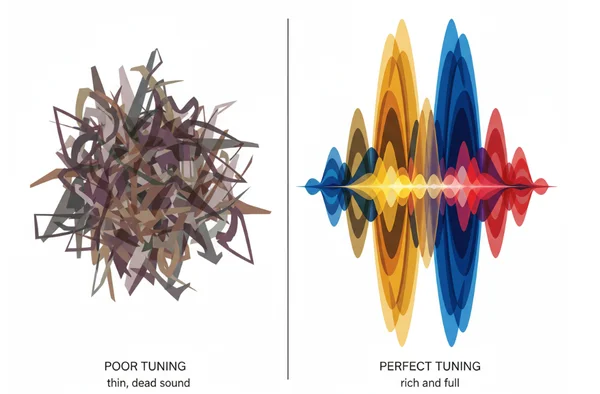
If your instrument is out of tune, even the most soulful performance will sound amateurish. Poor tuning ruins the "resonance" of your instrument. When an instrument is perfectly in tune, the wood and strings vibrate in sympathy with each other. This creates a rich, full sound. If you are out of tune, those vibrations cancel each other out, making the instrument sound thin and "dead."
How Different Genres Require Different Levels of Precision
While every genre needs tuning, some are more demanding than others:
- Classical & Jazz: These genres often use complex chords with many notes. If one note is slightly off, the entire harmonic structure collapses.
- Rock & Metal: While distortion can hide some tuning errors, heavy riffs require perfect tuning to maintain "punch" and clarity.
- Recording: In a studio environment, every cent matters. Small errors become magnified when you layer multiple tracks of the same instrument.
Beyond Just Playing in Tune: Intonation and Performance
Tuning is the start, but "intonation" is the journey. Intonation refers to how well an instrument stays in tune across its entire range. For example, your guitar might be in tune on the open strings, but sound sharp when you play a chord at the 12th fret.
Using a precise online tuner allows you to check your intonation. By testing notes at different frets, you can see if your instrument needs a professional setup. This ensures that you sound great no matter where you are playing on the neck.
The Path to Perfect Pitch
Once you grasp the fundamentals of pitch, cents, and frequencies, you'll see your instrument in a whole new light. You are no longer just turning knobs; you are mastering the physics of sound. By recognizing that a semitone is made of 100 cents and that A440 is your North Star, you gain the confidence to perform at your best.
Music is a journey of continuous improvement. Think of yourself as a ninja refining your weapon—your ears and your equipment need regular sharpening too. Don't settle for "close enough" when it comes to your sound. Precision is the key to unlocking your full potential.
Ready to put this knowledge into practice? Experience the power of professional-grade precision with our free online tuner. Visit our free online tuner today to achieve perfect pitch and take your musical performance to the next level.
Frequently Asked Questions About Pitch and Tuning
What is the difference between cents and semitones?
A semitone is the smallest standard interval in Western music (like the distance from C to C#). A cent is a much smaller unit used to measure the "micro-pitch" within a semitone. There are exactly 100 cents in one semitone.
How does an online tuner detect pitch so accurately?
Online tools like TunerNinja use the "Fast Fourier Transform" (FFT) algorithm. This technology analyzes the audio signal from your microphone, identifies the strongest frequency, and compares it to a database of musical notes. Advanced versions can achieve ±0.1 cent accuracy. You can start tuning now to see how the software visualizes your sound waves.
Can I really hear the difference between 1 cent and 2 cents?
Most people cannot hear a 1-cent difference in isolation. However, if two instruments play the same note and one is 2 cents off, you will hear a "pulsing" or "beating" sound. This interference is very noticeable and makes the music sound unstable.
Why do some instruments need to be tuned more frequently than others?
Instruments made of wood and metal, like guitars and violins, are sensitive to temperature and humidity. Heat causes materials to expand, while cold causes them to contract. Even a small change in the room's temperature can shift your strings by several cents.
How do I develop my ear for detecting pitch differences?
The best way is to use a high-precision tuner every time you practice. By looking at the visual feedback while listening to the note, you create a "feedback loop" in your brain. Over time, you will start to recognize when a note is flat or sharp before the tuner even tells you!